
Sachin Dahar
Beyond a Single Song: Sachin Dahar’s Expanding Work Reflects a New Chapter as a Singer
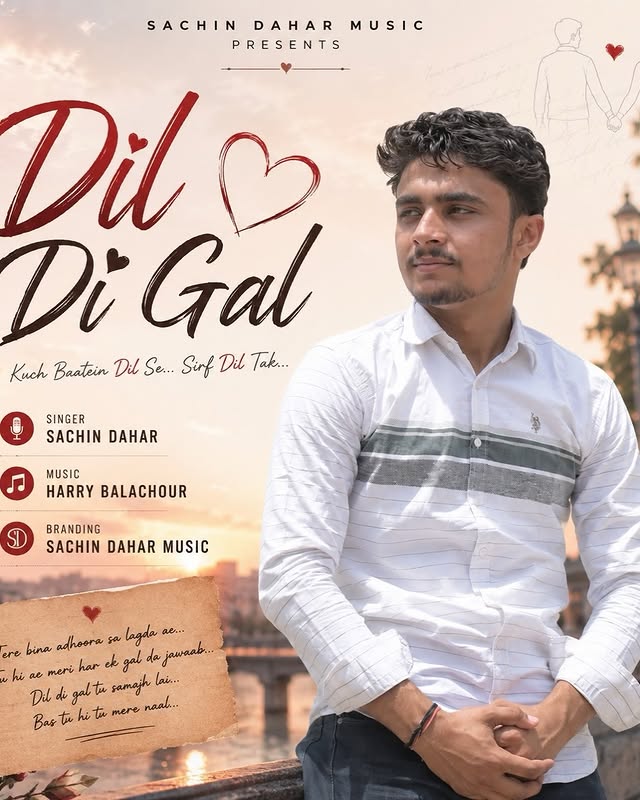
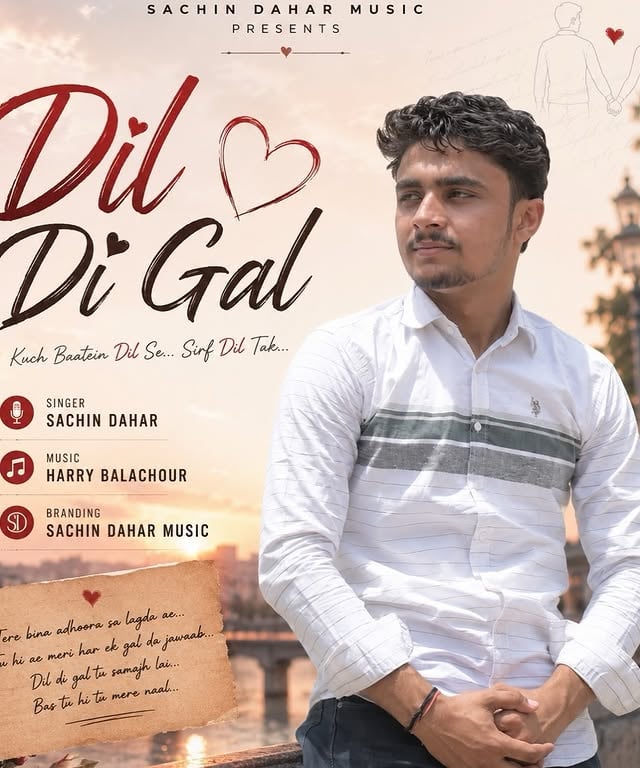

A music career is rarely defined by one moment. For many singers, recognition develops gradually as individual projects begin connecting into a larger body of work. Songs introduce the voice, collaborations create new associations, and each additional project adds another piece to an artist’s professional journey. Sachin Dahar is building that kind of musical record through a series of projects that place his work as a singer at the centre.
His portfolio includes Kaale Sheshe (feat. Malwai Partap), My Zone (feat. Malwai Partap), Raat Da Raja, Dil Di gal, Kudi Online (feat. Harry Balachour), Tikki Ki theli (Punjabi Beat), Pal Pal Jena (feat. Harry Balachour), Pini Chod Di (feat. Harry Balachour), Pite Nahi Ham, Sharab, System Hang, The Protest and Raaj Chale.
Taken individually, these are separate music projects. Seen together, however, they provide a broader view of Dahar’s work as a singer and show how his name has become connected with multiple titles and recurring collaborators.
From Individual Credits to a Broader Body of Work
There is an important difference between being known for a particular song and having a portfolio that allows audiences to explore several projects.
Sachin Dahar’s current body of work is increasingly about the latter.
With multiple titles associated with his singing, there is no requirement for one song to carry the entire weight of his musical identity. A listener who knows one project has several others to explore, while someone discovering Dahar through a featured collaboration can encounter a different side of his project history through the rest of the catalogue.
This gradual accumulation of work is a fundamental part of building a career in music.
It creates context around an artist’s name. Instead of appearing beside a single title, the singer becomes connected with a network of projects that collectively establish a more substantial professional record.
For Sachin Dahar, that network currently stretches across thirteen music projects.
Five Collaborations Create Recurring Artist Connections
A noticeable feature of Dahar’s project history is the presence of recurring collaborators.
Five titles involve either Malwai Partap or Harry Balachour, giving the collaborative side of his work a clear place within the larger portfolio.
Malwai Partap features on Kaale Sheshe and My Zone. These two projects connect Sachin Dahar and Malwai Partap across more than one title, creating a repeated association between the artists.
The same pattern becomes even more visible through Dahar’s projects featuring Harry Balachour.
Kudi Online, Pal Pal Jena and Pini Chod Di all feature Harry Balachour. The three titles form a separate collaborative thread running through Sachin Dahar’s work.
What is notable here is not an assumed musical similarity between the songs—the available information does not establish that—but rather the fact that these collaborations extend across several projects.
That creates continuity.
A listener encountering one collaboration may recognize the artist names again on another project, while still having the opportunity to explore Dahar’s work beyond those partnerships.
Kaale Sheshe and My Zone Connect Sachin Dahar With Malwai Partap
Among the projects involving featured artists, Kaale Sheshe (feat. Malwai Partap) and My Zone (feat. Malwai Partap) establish one recurring collaboration.
Sachin Dahar’s role as singer connects the two titles from his side, while Malwai Partap’s featured presence creates the second common link.
Rather than assigning either song a genre, lyrical meaning or audience demographic without supporting information, the projects can be understood through something more concrete: they are two distinct entries in Dahar’s musical portfolio involving the same featured artist.
That alone makes the pairing noteworthy within his project history.
Repeated collaborations can become recognizable markers in an artist’s catalogue. They allow audiences to encounter familiar creative names across different titles while each project continues to exist independently.
For Dahar, Kaale Sheshe and My Zone represent that type of connection.
Kudi Online, Pal Pal Jena and Pini Chod Di Form Another Collaborative Thread
Harry Balachour appears across a larger group of projects associated with Sachin Dahar.
The three titles are Kudi Online (feat. Harry Balachour), Pal Pal Jena (feat. Harry Balachour) and Pini Chod Di (feat. Harry Balachour).
Rather than appearing as a one-time featured name, Harry Balachour is connected with Dahar across three separate projects.
This gives the collaboration a visible place within the singer’s wider body of work.
It also demonstrates how a catalogue can develop internal connections without every release being treated as part of the same series. The titles remain separate, yet the recurring names allow listeners to identify a relationship between them.
For an artist developing a professional portfolio, these connections can help provide continuity between otherwise independent projects.
They also create an interesting contrast with the rest of Sachin Dahar’s work, where a number of titles do not carry either Malwai Partap or Harry Balachour as featured names.
The Catalogue Moves Beyond Featured Collaborations
While collaborations form an identifiable part of the story, they do not account for the majority of Dahar’s current project list.
That wider side of the portfolio includes Raat Da Raja, Dil Di gal, Tikki Ki theli (Punjabi Beat), Pite Nahi Ham, Sharab, System Hang, The Protest and Raaj Chale.
These titles are important because they prevent Sachin Dahar’s musical profile from being understood only through the artists appearing alongside him.
They give his singing work a broader foundation.
Each also provides a separate search and discovery point for audiences. Someone encountering Raat Da Raja does not necessarily follow the same path as someone discovering System Hang. Likewise, a listener finding Sharab may arrive at Dahar’s work independently of the collaborations featuring Malwai Partap or Harry Balachour.
The projects therefore work both individually and collectively.
Different Titles Give the Portfolio Its Own Character
One of the easiest mistakes when discussing a singer’s catalogue is to assume that a song title reveals everything about the music behind it.
Sachin Dahar’s project names are varied, but that variation should not be turned into invented descriptions.
Raat Da Raja has a different title from Dil Di gal. Tikki Ki theli (Punjabi Beat) stands apart from both, while Sharab and Pite Nahi Ham introduce another pair of recognizable names.
Further along the list are System Hang, The Protest and Raaj Chale.
The titles are enough to distinguish the projects from one another. There is no need to label System Hang as a club song, The Protest as a political record or Dil Di gal as a romantic ballad unless information about the actual music establishes those descriptions.
That factual approach matters when documenting an artist’s career.
A credible profile should separate confirmed information from interpretation, particularly when discussing projects whose titles may invite assumptions.
What can clearly be established here is Sachin Dahar’s role as singer across the collection.
Sharab, Pite Nahi Ham and the Value of Individual Recognition
Among the titles associated with Dahar, Sharab and Pite Nahi Ham are particularly easy to remember because of their contrasting names.
But rather than constructing an artificial connection between them, each can be viewed as its own entry within the singer’s project history.
The same principle applies to Raat Da Raja and Dil Di gal.
An expanding catalogue benefits when individual titles remain recognizable instead of being reduced to a generic list. For listeners, every project can become the first point of contact with the singer.
That means the importance of a title is not limited to where it sits chronologically or whether another artist is featured. Its role also comes from adding another identifiable piece of work to the artist’s overall portfolio.
For Sachin Dahar, the accumulation of these individual projects is gradually creating a much wider musical footprint.
System Hang, The Protest and Raaj Chale Add Three More Distinct Names
Another interesting group within Dahar’s work consists of System Hang, The Protest and Raaj Chale.
The titles differ considerably from one another, giving each project an immediately separate identity on paper.
Sachin Dahar contributes as a singer across these works, adding them to the same professional journey as his earlier titles and collaborations.
Their inclusion also makes the overall portfolio harder to define through a single project.
If an artist has only one or two titles, audiences can easily associate the entire profile with those songs. Once that body of work becomes larger, the identity begins shifting from a particular song toward the person behind the collection.
That transition is an important stage in the development of a singer’s career.
Music Discovery No Longer Follows One Route
The way audiences find music has changed considerably from the era when radio, television or physical albums were the dominant gateways to new singers.
Today, discovery can happen through an individual music video, an artist search, a collaborator, a recommendation or simply a project title that attracts attention.
This makes a varied catalogue particularly valuable.
Consider the different paths surrounding Sachin Dahar’s work. A person following Malwai Partap has Kaale Sheshe and My Zone as possible introductions. Someone interested in Harry Balachour has three other projects through which Dahar’s name can appear.
Another listener may have no connection with either featured artist and instead encounter Sharab, Raaj Chale, Raat Da Raja or The Protest.
Each path begins differently, yet all can lead toward the same singer.
This is where having multiple projects starts becoming more meaningful than simply having a longer list of credits. The catalogue develops connections between separate audiences and separate pieces of work.
Sachin Dahar’s Role Remains the Connecting Point
Despite the different project titles and featured names, one element remains consistent throughout: Sachin Dahar’s role as a singer.
That consistency gives the portfolio a clear centre.
Kaale Sheshe and My Zone establish the Malwai Partap connection. Kudi Online, Pal Pal Jena and Pini Chod Di establish the Harry Balachour connection.
Meanwhile, Raat Da Raja, Dil Di gal, Tikki Ki theli (Punjabi Beat), Pite Nahi Ham, Sharab, System Hang, The Protest and Raaj Chale expand the picture through additional projects.
The result is not simply a collection of names. It is a record showing the singer across multiple pieces of work.
And as that record grows, the emphasis naturally begins moving from individual credits toward the larger career being formed around them.
A Musical Identity Taking Shape Project by Project
There is no reliable shortcut to building a body of work.
Recognition may sometimes arrive suddenly, but a professional catalogue develops one project at a time. Each title adds history, each collaboration creates another connection, and every new singing credit becomes part of what audiences can associate with an artist’s name.
That is the more interesting story surrounding Sachin Dahar at this stage.
His portfolio does not require exaggerated claims about chart positions, streaming numbers or breakthrough success to appear substantial. Nor does every song need an invented genre or storyline to make the catalogue interesting.
The projects themselves provide the foundation.
From his recurring collaborations with Malwai Partap and Harry Balachour to titles such as Raat Da Raja, Sharab, System Hang and Raaj Chale, Dahar is developing a musical record that gives audiences more than one way to encounter his work.
As that journey continues, individual songs will retain their own identities, but their collective value may become even more significant.
For Sachin Dahar, the larger story is increasingly about the body of work taking shape around his name—a catalogue built through singing, collaboration and a growing number of distinct music projects.